
Pennsylvania – Few days ago, Sen. John Fetterman of Pennsylvania joined Republicans in a key Senate vote to advance Kevin Warsh, President Donald Trump’s nominee to lead the Federal Reserve.
Once again, he drew huge attention inside the Democratic party.
The Senate voted 49-44 to move the nomination forward, with Republicans staying united and only two Democrats, Fetterman of Pennsylvania and Chris Coons of Delaware, crossing party lines.
The vote comes as Fetterman continues to distance himself from the party’s progressive wing on several major issues, including Israel, border security, government shutdowns and some Trump nominees.
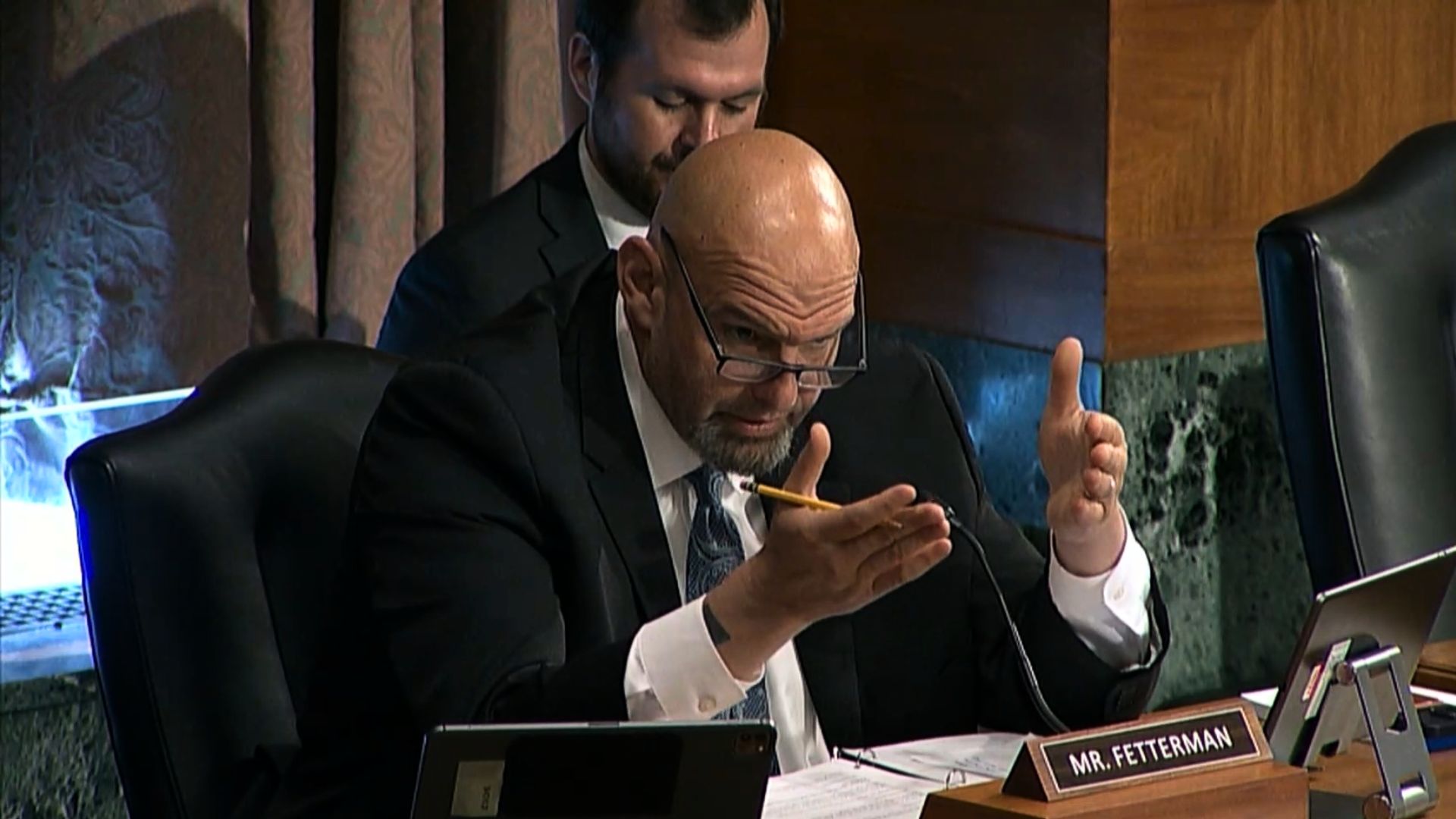
He recently said he feels increasingly “lonely” inside his own party, arguing that Democratic values have shifted in ways that make it harder for him to stay aligned with the caucus.
Now again, Sen. Fetterman is drawing a hard line between himself and parts of the Democratic Party, arguing that the political movement he once found appealing has moved into territory he can no longer defend.
The Pennsylvania Democrat made the remarks Wednesday during an appearance on the “Reason Interview” podcast, where host Nick Gillespie asked him to reflect on his politics today compared with 2016, when Fetterman supported Sen. Bernie Sanders of Vermont and was widely viewed as a progressive outsider with blue-collar appeal.
Fetterman said the movement he backed nearly a decade ago was rooted in issues such as wages and basic economic fairness.
In his view, that focus has changed.
“Well, I mean, you know, in 2016, it was much more about the minimum wage and some other very basic kinds of thing,” Fetterman said on the podcast, according to Reason.
“And now that’s, that’s just turned into much more standing with like Cuba, standing with Venezuela, standing with the Iranian regime and, and turn that into much more becoming more increasingly anti-American for me. So, my views really haven’t changed that much.”
The comments came amid debate inside the party over U.S. policy toward Venezuela, Iran and Cuba, and they fit into a broader pattern for Fetterman, who has repeatedly accused Democrats of losing touch with voters outside the party’s most activist circles.
Fetterman rejected the idea that he has drifted away from his earlier beliefs.
He pointed to his long-standing support for marriage equality as an example, saying he was willing to take political risks on that issue before it became a more settled position within the Democratic Party.
“What’s really changed is the party,” he continued.
“And in 2024, I was campaigning for Kamala Harris there as a Democrat. It was very clear we were going to lose. And a lot of the excesses that we’ve had in 2020 came back to revisit … the excess of the party back then summoned the second term of the Trump administration.”
That argument has become central to Fetterman’s political identity. Since winning the seat once held by former Republican Sen. Pat Toomey in 2022, he has insisted that he remains a Democrat, but not one willing to follow every party instinct.
His criticism has often landed hardest on the party’s left flank, especially on foreign policy, border security, energy, Israel and the role of technology in the economy.
In a recent op-ed published through his Senate office and originally appearing in The Washington Post, Fetterman pushed back against speculation that he might switch parties.
He wrote that elected Democrats “cannot simply be the opposite of whatever President Donald Trump says” and dismissed the idea of becoming a Republican, saying, “I’d be a terrible Republican who still votes overwhelmingly with Democrats.”
Still, Fetterman has openly acknowledged that his position has left him isolated.
He has described serving this way as “increasingly lonely,” while arguing that working across party lines and delivering for Pennsylvania should matter more than partisan loyalty.
The senator also pointed to organized labor as a warning sign for Democrats. For generations, unions were a backbone of the party’s coalition, especially in industrial states such as Pennsylvania. But Fetterman said that connection has been badly weakened as many traditional union voters have moved toward Trump and the Republican Party.
“And now I think we effectively can count that a lot of those traditional union members have already left the Democratic Party,” Fetterman said.
“And that’s where we are. And it’s been a serious realignment of parts of our base.”
Fetterman’s break with many Democrats has been especially visible on Israel. He has strongly rejected claims, made by some Democrats and former Rep. Marjorie Taylor Greene, that Israel has committed genocide in Gaza.
Responding to Greene’s remarks in 2025, Fetterman said, “It’s not a genocide, you know, that’s just not the case. And she’s entitled to her opinion, but I’m entitled to not really care what her views on that is.”
He has also criticized Democrats who oppose rapid development of artificial intelligence and data centers, calling that opposition “lunacy.”
For Fetterman, the message is simple but politically explosive: he says he has not abandoned the Democratic Party.
He believes parts of the party have abandoned the older coalition that once made Democrats competitive with working-class voters, union households and political moderates. And as Trump’s second term reshapes Washington, Fetterman is making clear that he has no interest in being a quiet passenger on that ride.

