
Myrtle Beach, South Carolina – Elaine Rivers used to know where Conway ended and the country began. There was a bend in the road, a line of trees, a stretch of quiet after the traffic light. She could drive from her house toward Myrtle Beach and still feel, for a few minutes, that the Grand Strand had not swallowed everything between the river and the ocean.
Now she passes new roofs, new turn lanes, new subdivision signs, new storage buildings, new clearing work and new traffic that seems to arrive before the roads do.
“You wake up one day and the woods are gone,” Elaine said. “Then they tell you the growth is good for everybody. Maybe it is. But nobody asks what it costs the people already here.”
That is the boomtown backlash spreading across parts of South Carolina, especially in Horry County, where Myrtle Beach, Conway, Carolina Forest, Little River and nearby communities are absorbing growth at a speed that has turned development into a daily argument.
The issue is not whether people should be allowed to move to South Carolina. They are moving because the state offers what many families and retirees want: lower taxes, warmer weather, jobs, beaches, space and a slower image of life than the places they left.
The issue is whether growth is being planned carefully enough to protect the people and places already here. Horry County had 427,551 residents in 2025, up from about 351,000 in 2020. That is a 21.8% increase in just five years. The county also had 237,830 housing units and issued 6,511 building permits in 2025.
Those numbers are not abstract to Elaine. They are the reason her morning drive takes longer. The reason her grandson’s school feels crowded. The reason rainwater sits longer near the ditch behind her cousin’s house. The reason people at church talk about rezoning almost as much as they talk about weather.
“Growth sounds clean when officials say it,” she said. “But where I live, growth has mud on its tires.”
Read also: In the Pee Dee, bad roads and daily traffic are turning short drives into long frustrations
A county growing faster than its patience
The Myrtle Beach-Conway-North Myrtle Beach metro area ranked third nationally for population growth from 2023 to 2024, increasing 3.8%, according to the U.S. Census Bureau. Horry County has kept growing since then.
Growth has brought real benefits. More customers for small businesses. More homes. More tax revenue. More restaurants, medical offices, retail centers and jobs. The Myrtle Beach area remains one of South Carolina’s economic engines, with tourism, real estate and services feeding much of the local economy. But growth also changes the ordinary experience of living in a place.
Elaine works part time at a dental office and helps care for her mother, who still lives near Conway. A trip that used to be easy now depends on the time of day, the season and whether there is construction, a crash or beach traffic. She avoids certain roads on Saturdays. She plans doctor appointments around school dismissal. She knows which grocery store parking lot will be impossible after 4 p.m.
“It’s not one big thing,” she said. “It’s every little thing taking longer than it used to.”
Horry County’s mean travel time to work was 23.1 minutes, according to Census data from 2020 to 2024. But averages smooth out the pain. They do not show the backups near Carolina Forest, the pressure on U.S. 501, the growing traffic near Conway, or the way tourist season changes local routines.
The county’s RIDE 4 transportation program, which went into effect May 1, 2025, is meant to help. Horry County says the one-cent transportation sales tax will support road and infrastructure projects over 25 years, with an estimated $6 billion in revenue for predetermined projects. That is a serious investment. It is also a sign of how far behind residents feel the road system has fallen.
New homes, old roads
A subdivision can go up quickly. A road project does not. That mismatch sits at the heart of the frustration. Residents see land cleared, homes framed, signs planted and moving trucks arrive. But road widening, drainage improvements, turn lanes, school capacity and emergency services move on a different clock.
Horry County’s own planning materials have warned for years that growth would push the area hard. The county’s Imagine 2040 materials describe the comprehensive plan as a guide for decisions through 2040 and note that planning touches land development, transportation, community facilities, natural resources and priority investments.
Older county population projections said Horry could reach about 584,000 residents by 2040, and that with seasonal population included, the county could easily reach more than half a million people on a peak day. Those projections were made before the latest post-pandemic growth surge.
For residents, the result is a feeling that development decisions are being made one project at a time, while the consequences arrive all at once. Elaine does not oppose new housing. Her daughter rents. Her nephew wants to buy. She understands that stopping all construction would only make homes more expensive.
But she also sees what happens when every field becomes “the next phase.”
“You can’t say yes to every subdivision and then act surprised when the road is full,” she said.
Read also: In South Carolina, child care is becoming the job before the job
Housing is being built, but affordability is still strained
One promise of rapid development is that more housing should ease prices. In some ways, Horry County is building aggressively. The Federal Reserve Bank of St. Louis, using Census building permit data, shows Horry County authorized 6,511 new private housing structures in 2025, after 7,331 in 2024 and 6,513 in 2023.
But more rooftops have not made everyone feel secure. Zillow estimated the average Horry County home value at $319,197 as of May 31, 2026. RentCafe listed the average Myrtle Beach apartment rent at $1,599, with two-bedroom apartments averaging $1,688 and three-bedroom apartments averaging $1,933.
Those numbers may look modest compared with Charleston or parts of Florida. But Horry County’s median household income was $66,880 from 2020 to 2024. For workers in tourism, health care support, retail, restaurants, schools and public services, the new housing market can feel like it was built for someone arriving with a bigger paycheck or a home sale from another state.
That is the uncomfortable part of boomtown growth. A community can add housing and still price out local workers if the buyers arriving have more money than the people already living there. Elaine sees that in her daughter, who works full time but still shares a rental with a friend.
“She grew up here,” Elaine said. “Now she has to compete with people who sold a house somewhere else and came here with cash.”
Schools and services feel the pressure
Growth does not stop at the subdivision entrance. Children need classrooms. Families need fire protection. Older residents need ambulances. New neighborhoods need parks, drainage, libraries, sheriff’s patrols and safe intersections. Those services cost money, and they often arrive after residents have already started feeling the strain.
Horry County Schools has already faced capacity pressure. In 2024, local reporting on district projections found that 21 schools were expected to be at 95% capacity or higher, with some Carolina Forest-area schools projected above 130%. District officials pointed to modular classrooms and new schools as short-term and long-term responses.
For parents, capacity is not just a facilities issue. It affects drop-off lines, classroom space, teacher workload, bus routes and whether a school still feels like a neighborhood school. Elaine’s grandson attends elementary school in a growing area. She says the school staff is kind, but the parking lot tells the story.
“You can feel the growth before the bell rings,” she said. “Cars everywhere. Kids everywhere. Everybody rushing.”
The same pressure shows up in debates over impact fees. Horry County has considered changes to development impact fees, which are meant to help growth pay for infrastructure and services. A 2026 county impact-fee study described planning for capital improvements and development impact fees, while local reporting said proposed changes could adjust fees by home size.
The debate is difficult because both sides have a point. Higher fees can help pay for roads, stormwater, fire, parks and other needs. They can also raise the cost of construction, which may be passed to buyers and renters. But the alternative is not free. If growth does not pay enough as it arrives, existing residents pay later through taxes, traffic, crowded services or delayed repairs.
Water has nowhere to go
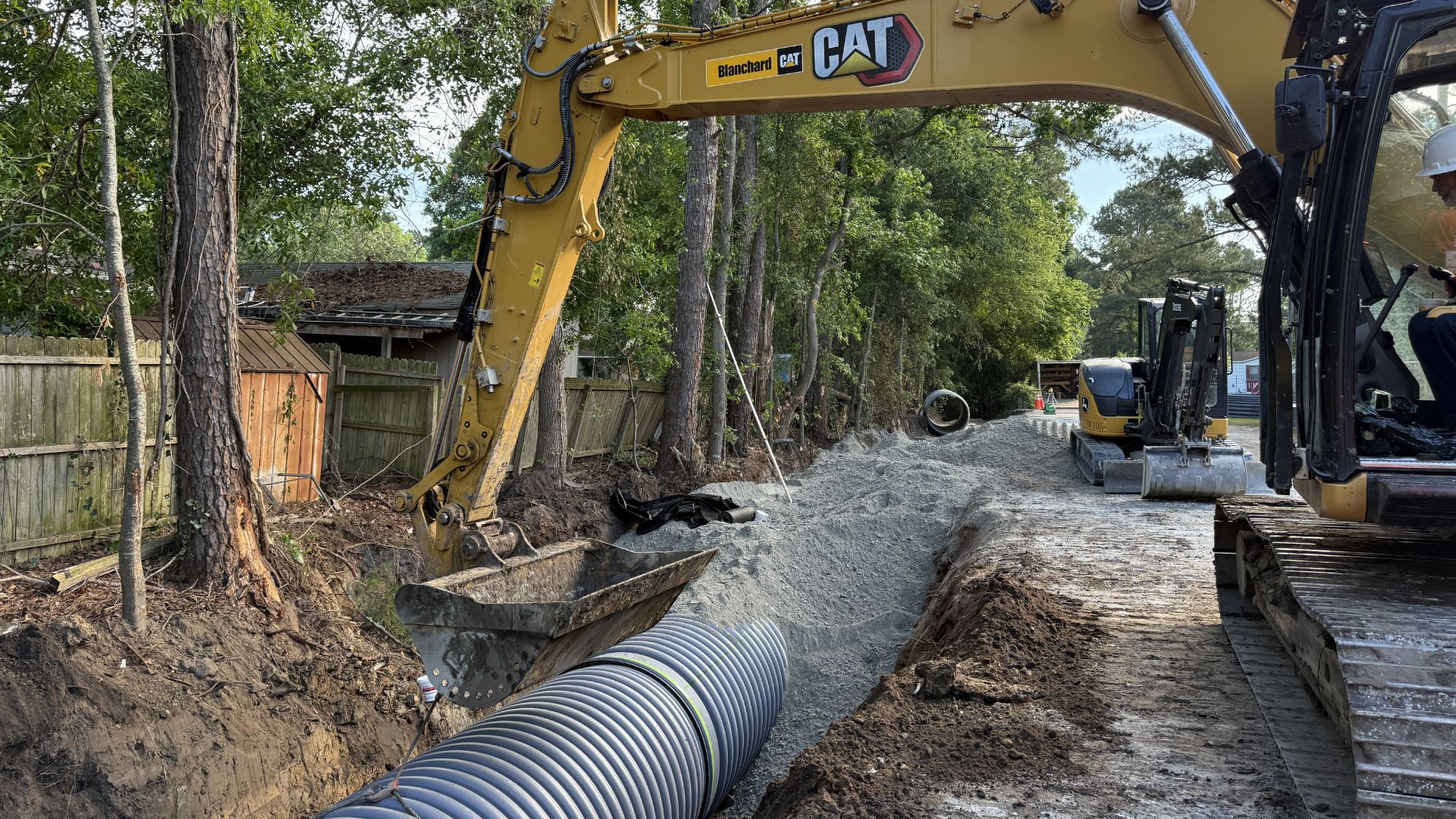
In Horry County, overdevelopment is not only about traffic and rooftops. It is also about water. The county is low-lying, coastal and flood-prone. When land is cleared and covered with pavement, roofs, driveways and roads, stormwater has to go somewhere. If drainage systems are old, undersized or poorly connected, that water can end up in yards, streets and homes.
Horry County reported that its Stormwater Capital Improvement Program advanced drainage and flood mitigation work in 2025, including major drainage improvements, aging infrastructure replacement, system inventories in older neighborhoods and watershed-level studies to guide future investments. One county update described work on the Cartwheel Watershed and Aquilla Estates as part of broader 2025 milestones and 2026 goals.
That work matters. But the need keeps growing. Elaine’s cousin lives near a ditch that fills faster than it used to. Nobody in the family pretends one subdivision caused it. The worry is cumulative. One cleared parcel. One new road. One retention pond that works on paper. One heavy rain. Then another.
“You hear the word drainage and think pipes,” Elaine said. “But for families, drainage is whether the water gets close to the back door.”
A place can grow and still lose something
The hardest part of growth is not always measurable. People can argue over traffic counts, tax revenue, school capacity and building permits. It is harder to measure the loss of a tree line, a quiet road, a familiar view, a sense that residents understand what kind of place they live in.
Myrtle Beach and Horry County have always changed. Tourism changed them. Highways changed them. Retirement migration changed them. Remote work changed them. There is no version of the Grand Strand frozen in time. But residents are not wrong to ask whether the current pace is too fast, too scattered or too reactive.
Overdevelopment is not simply development someone dislikes. It is what happens when growth outruns planning. When homes arrive before roads. When schools fill before classrooms. When drainage problems are solved after flooding. When workers cannot afford the communities they serve. When residents start to believe public hearings are a formality and the real decisions have already been made.
That belief is dangerous because it weakens trust. Elaine still attends county meetings when she can. Sometimes she leaves encouraged. Sometimes she leaves convinced that ordinary residents speak in minutes while developers speak in plans.
“I don’t think all development is bad,” she said. “I think bad development makes people feel powerless.”
What responsible growth would mean
Horry County does not have the option of pretending people will stop coming. The better question is what kind of growth the county will allow, where it will go and what must be in place before it happens.
Responsible growth would mean aligning zoning decisions with road capacity, school planning, stormwater systems and emergency services. It would mean protecting wetlands and flood-prone areas before they become problems. It would mean making infrastructure costs clear and fair. It would mean building housing that local workers can afford, not only homes for newcomers with outside wealth. It would mean giving residents a real voice before the land-clearing starts.
It would also mean admitting that growth is not automatically good just because it increases the tax base. Growth can strengthen a community. It can also thin it out, stretch it, flood it, crowd it and make longtime residents feel like guests in their own home.
Elaine’s daily drive includes passing past another cleared parcel near a road she has used for decades. The trees were gone. The dirt was fresh. A sign promised a new community coming soon.
She sometimes slows down to see what will soon be only a memory. And traffic almost immediately forms behind her.
“That sign says coming soon,” she said. “But for us, it already came.”

